Better Harnesses > Lower Limits: Why Priset is 64% Faster and 56% Cheaper than Claude Code

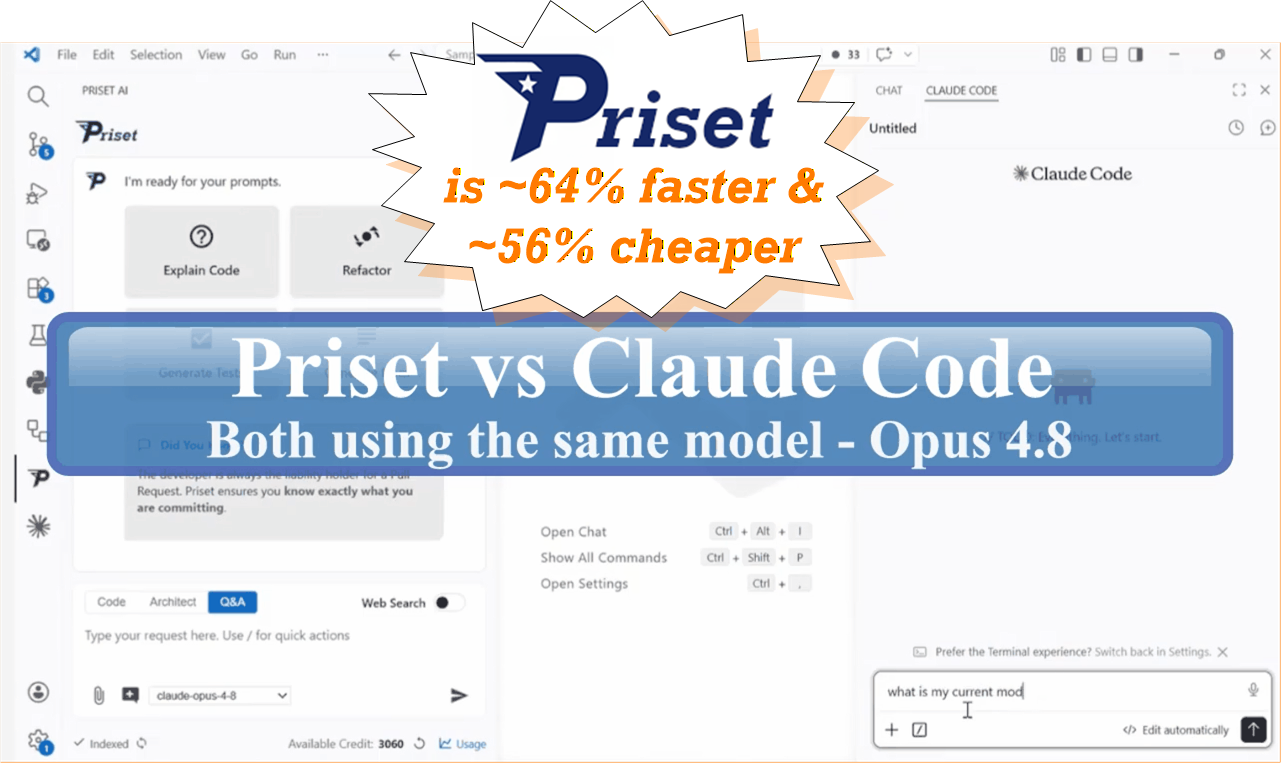
Recently, a prominent startup founder shared a terrifying reality of the June 1st shift to per-token AI pricing: their Anthropic bill is jumping from $400K to $1.4M a year. The founder admitted to accidentally spending $4,000 in just three days using Claude Code.
The industry's knee-jerk reaction? Imposing strict spend limits and capping developers.
With respect, capping your engineers is the wrong answer. The problem isn't that your team is coding too much; the problem is that they are engaging in "blind vibe coding" using Black Box AI tools. The cost of an AI guessing your architecture, getting it wrong, and burning massive context windows to rewrite it is what we call the Hallucination Tax.
You don't need lower limits. You need a better harness.
To prove this, we benchmarked Priset directly against Anthropic's own Claude Code.
The Benchmark Setup
We set up a side-by-side test in the VS Code IDE.
- The Codebase: MedicoGenAI - a complex mobile platform that is revolutionizing medical documentation with an ambient AI.
- The Model: Both tools were powered by the exact same model: Opus 4.8.
- The Tasks: 3 different tasks of escalating complexity. (We ran Task 1 three times to prove consistency).
The Hypothesis: If the underlying LLM is exactly the same, any difference in speed and cost is entirely dictated by the efficiency of the IDE harness.
The Results: Priset Dominates on Efficiency
Across all 5 test runs, Priset dramatically outperformed Claude Code in both speed and cost-efficiency.
| Metric | Claude Code (Avg) | Priset (Avg) | Difference |
|---|---|---|---|
| Run Duration | 112.8 seconds | 40.6 seconds | Priset is ~64% faster |
| Cost Per Run | $0.242 | $0.106 | Priset is ~56% cheaper |
But averages only tell half the story. The real danger of "blind vibe coding" reveals itself when tasks become complex.
Task 1: The Baseline Consistency
We ran Task 1 three separate times. Across all three runs, Priset maintained a consistent lead. In Run 2, even when the speeds were almost identical (37s vs 38s), Priset was exactly half the price ($0.09 vs $0.18).
Watch the Task 1 runs:
Task 2: Stepping Up Complexity
As we introduced a harder prompt, Claude Code began to stumble, taking 2 minutes and 7 seconds to search the codebase and formulate an answer.
Priset completed the exact same task in 33 seconds—nearly 4x faster—for a fraction of the cost ($0.09 vs $0.28).
Watch the Task 2 run:
Task 3: The Ultimate Stress Test (7.3x Faster)
This is where the Hallucination Tax becomes undeniable. Faced with a highly complex architectural request, Claude Code's Black Box brute-force approach broke down. It took nearly 5 minutes (291 seconds) and cost $0.30 to finally output the correct answer.
Priset completed the exact same task, using the exact same Opus 4.8 model, in just 40 seconds for $0.12.
That is 7.3x faster and 60% cheaper.
Watch the Task 3 run:
Why is Priset So Much Faster and Cheaper?
How can two tools using the exact same API have such a massive disparity in performance? It comes down to Glass Box vs. Black Box architecture.
Claude Code operates as a Black Box. When you give it a prompt, it blindly searches your codebase, stuffing the context window with massive amounts of data, hoping to find the right seams. If it gets it wrong, it wipes its cache and tries again. You pay for every single token it churns through.
Priset uses a Glass Box architecture.
- Implementation Blueprints: Before Priset writes a single line of code, it maps several blueprints and the developer chooses the best one to proceed with. Because the AI isn't guessing your architecture, it gets it right the first time.
- Precision Context Routing: We only send hyper-relevant snippets to the LLM.
- Native Caching: Because we aren't brute-forcing dead context or resetting mid-session, our native caching stays intact. Your cached tokens cost a fraction of the price.
The Era of Token-Maxxing is Over
The Bespoke Economy is here. Enterprise engineering teams and "Local CTOs" cannot afford to burn budgets on bloated API context windows.
With Priset’s Bring Your Own Key (BYOK) model, you pay a flat SaaS fee for the ultimate IDE harness, plug in your own Claude, Gemini, or ChatGPT keys, and ensure your IP stays secure while keeping your API costs strictly grounded.
Don't throttle your engineers. Stop paying the Hallucination Tax. Give them a better harness.
Try Priset & Connect Your BYOK Today
Priset's Glass Box AI is available now for VS Code, Visual Studio and JetBrains. Experience transparent, 100x velocity today.