Your AI Co-Pilot Can't Explore. Yours Should.

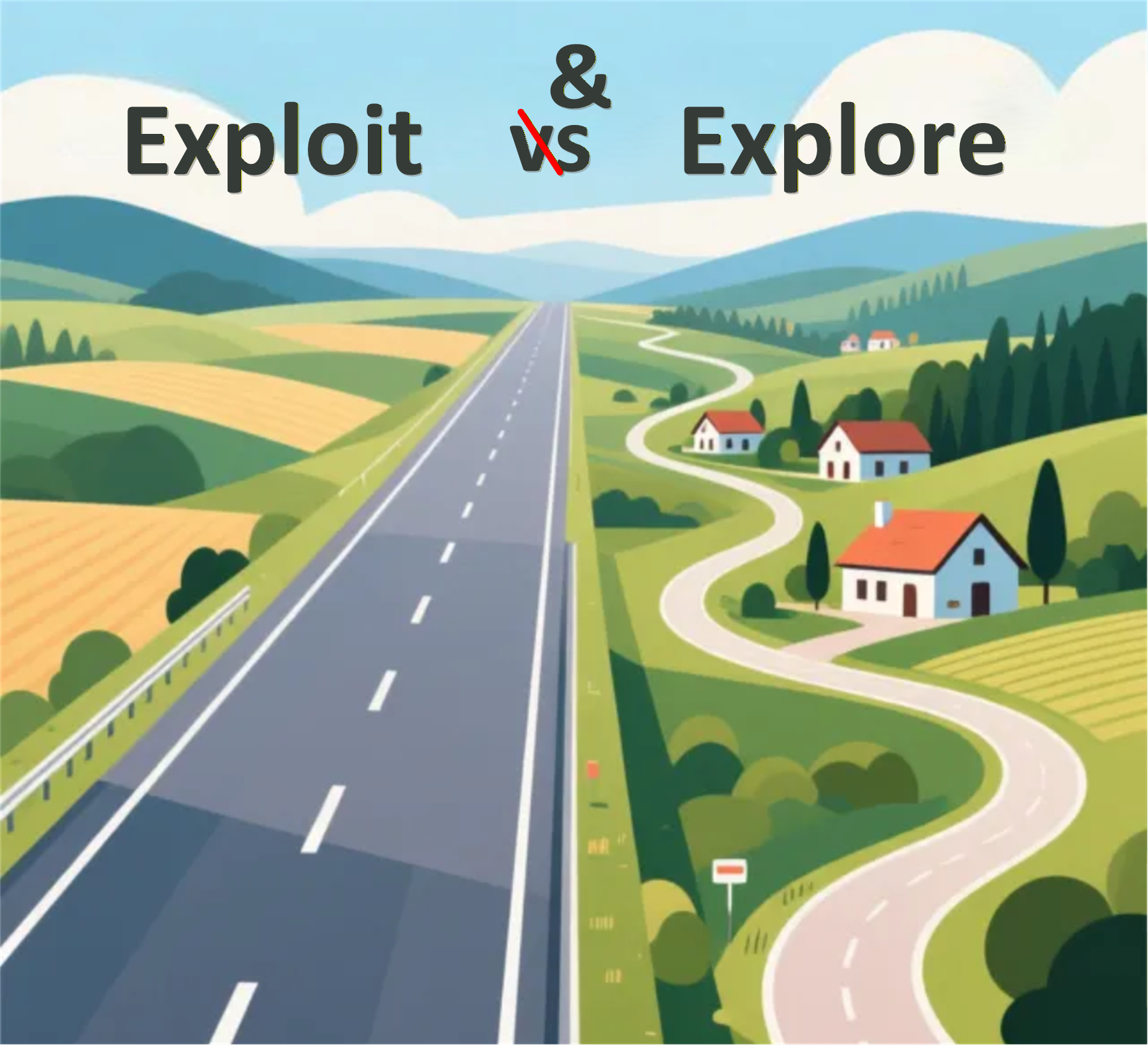 In every business, on every team, there are two fundamental forces at play: Explore and Exploit.
Exploit is the relentless optimization of what you already know works. It's about efficiency, predictability, and minimizing risk. It's the Walmart shopping trip: you have a list, you know the aisles, and your goal is to get in and out as cheaply and quickly as possible. This is the domain of spreadsheets, quarterly targets, and rational decision-making.
Explore is the messy, uncertain, and often illogical search for what you don't know. It's about taking chances, getting lucky, and discovering new opportunities. It's the TJ Maxx trip: you wander the aisles aimlessly, not looking for anything in particular, hoping to stumble upon a brilliant find. This is the domain of creativity, intuition, and "wacky ideas."
As the brilliant marketing philosopher Rory Sutherland has argued, any healthy system—be it a business, an ecosystem, or a human life—needs a dynamic balance between these two forces.
But in the modern corporate world, the scales have tipped dangerously in one direction.
The Tyranny of the Exploiters
Take a moment and ask yourself: in your organization, who needs permission from whom?
The creative people—the explorers—must always package their uncertain, high-potential ideas and present them to the rational people—the exploiters—for approval. The explorers only have the power of suggestion.
The rational people, who manage the budgets and the roadmaps, have the power of veto.
This asymmetry is a silent killer of innovation. An idea that can’t be justified on a spreadsheet, that doesn’t have a predictable ROI, or that challenges the established way of doing things is almost always vetoed. The organization becomes incredibly efficient at executing its past successes, all while becoming blind to its future opportunities. It becomes a beehive where every bee must follow the same old instructions, unable to discover the new field of flowers just over the hill.
The Problem with Most AI Tools: They are Pure Exploiters
Now, bring AI into this picture. Most of today's AI development tools are designed to serve the exploiters. They are brilliant at optimizing known tasks: writing boilerplate code faster, refactoring a function more efficiently, generating predictable unit tests.
They are, in essence, the perfect tool for making the Walmart trip even more efficient.
But they can't help you with the TJ Maxx trip. They can't explore. They can't have a "wacky idea." They are designed to follow instructions with maximum efficiency, reinforcing the very "exploit" mindset that already dominates our industry. An AI that can only optimize the known path will only help you get stuck in a local maximum, faster.
Priset: The Great Rebalancing Act
We believe the true, revolutionary promise of AI is not to make the exploiters more powerful, but to democratize the power of exploration.
The single biggest barrier to exploration has always been the cost. A creative idea that requires three months and $100,000 of engineering time to build a prototype is an easy "no" from the rational veto-holders.
But what if that same prototype could be built by one person, in one afternoon, for less than the cost of a team lunch?
This is the future Priset is built for. By reducing the cost, time, and friction of turning an idea into a working reality to near zero, we fundamentally change the power dynamic.
- Bypass the Veto: A creative developer no longer needs to ask for permission to explore. They can just—build. They can use a sliver of their existing time to rapidly prototype a new feature, a new product, or a new integration.
- Present Proof, Not Slides: The conversation with leadership is no longer a hypothetical pitch from a PowerPoint deck. It's a live demo of a working MVP. The dynamic shifts from "Can we do this?" to "Look what I already did. Let's make it better."
- Make Everyone an Explorer: This capability isn't limited to R&D departments. A product manager can explore a new UX flow. A support engineer can build a tool to solve a recurring customer problem. Innovation is no longer confined to a silo; it can happen anywhere, driven by anyone with a good idea.
The future of business isn't about choosing between explore and exploit. It's about creating a culture where exploration is so cheap and accessible that the best ideas can flourish, validated by real-world proof, not just spreadsheet forecasts.
We're not just building a faster way to write code. We're building a lever to rebalance the scales, empowering the explorers to build the future.